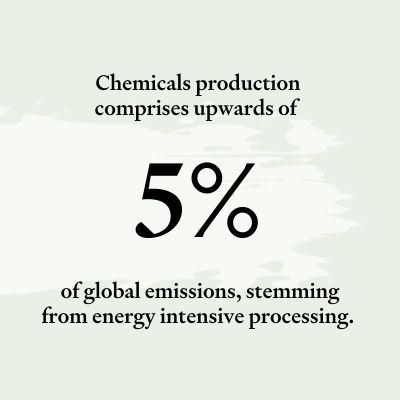
Chemicals production comprises upwards of 5% of global emissions, stemming from energy intensive processing. For instance, take the Haber-Bosch process, the dominant method for ammonia production estimated to support half the world’s population through its use as agricultural fertilizer. The process is century-old and requires half a dozen steps utilizing high temperature and pressure.
Yet, it is extremely difficult for green solutions to compete on cost against these incumbent processes. In many cases, green chemicals are fundamentally disadvantaged because they start from molecules that are too stable and require too much energy to convert them into reduced intermediates that the chemical industry is built upon. In contrast, the earth has done a bunch of the work already for fossil chemicals derived from hydrocarbons that are geologically pre-reduced, energy-rich feedstocks.
What if we could couple that energetic potential within the earth with advanced chemistry to precisely and safely produce the chemicals that we need, more abundantly and cheaper than ever before? And there’s no better time than now—recent advances in oil and gas subsurface engineering and next-generation geothermal have opened the way (e.g., precise horizontal drilling, resource stimulation, advanced reactive transport modeling, etc.)
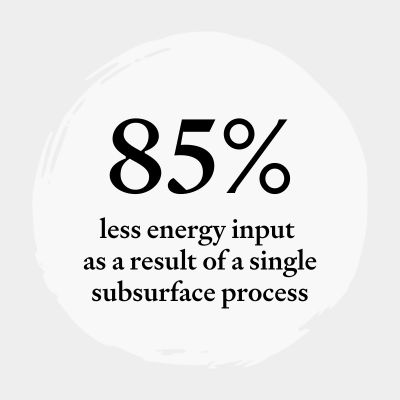
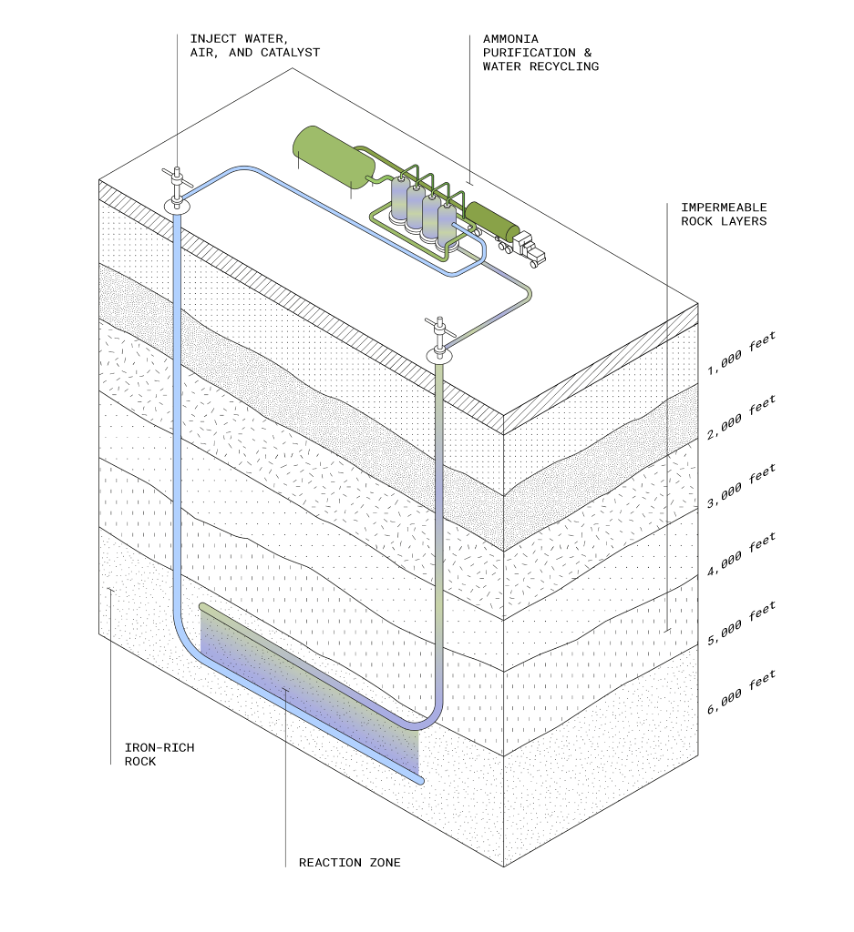
Addis Energy injects engineered fluids into the subsurface to produce hydrogen from abundant iron-rich rocks. However, unlike other startups focusing on geologic hydrogen that is difficult to capture, transport and store, the Addis team found that the addition of nitrogen would drive a cascading reaction to ammonia. The physics advantage is that the temperature, pressure, and reducing agents are contained within the subsurface, so they do not need to be generated. Furthermore, a single subsurface process, rather than three reactions in the case of Haber Bosch (methane reforming, water-gas shift, Haber-Bosch), means fewer reaction and separation steps. The result is 85% less energy input.
The technology platform could also extend into other chemical synthesis (by varying the input stream) and critical mineral co-production (as lixiviants are generated in the process). There is no risk of groundwater contamination, and the process operates well below groundwater zones, separated by thick, impermeable rock layers that act as natural barriers, coupled with well design.
Addis Energy can significantly undercut the levelized cost of ammonia production from Haber-Bosch. We’ve looked at many startups in this space and this is the first we’ve seen that can do so by reducing energy input by an order of magnitude.
The ammonia market also suffers from high exposure to natural gas prices, supply concentration, and extreme price volatility. Addis Energy can help alleviate these pain points by unlocking a globally distributed, abundant set of geological resources that decouple ammonia production from natural gas. These also have strong overlap with existing ammonia storage and distribution infrastructure.
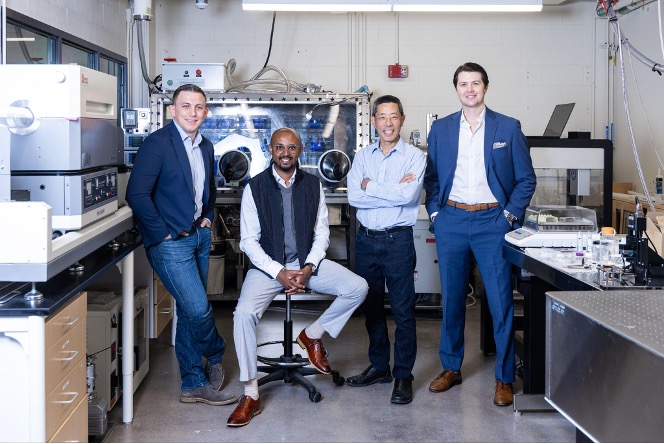
Addis Energy was founded in 2024 at the confluence of oil and gas expertise and technical innovation from MIT. Both CEO Michael Alexander and COO Charlie Mitchell come from oil and gas field and refinery operations. CSO Tim Abate, MIT Professor of Material Science and Engineering, developed the technology with support from ARPA-E and prolific inventor Yet-Ming Chiang.
The company is preparing for their first field pilot in2027.
“Addis Energy is not trying to “green” ammonia. They’re throwing out the model entirely. Instead of spending billions to recreate extreme pressure and heat above ground, they use what already exists underground. The Earth becomes the reactor,” said Laurie Menoud, Partner at At One Ventures. “Haber-Bosch is one of the most efficient industrial processes ever built, which is exactly why incremental innovations won’t compete with it. The only way to win is to change the physics and the system architecture. Addis is doing both. And that’s how you get a cost curve that incumbents simply can’t follow.”